
Ask an owner who they compete against and you’ll get a blank stare or the name of the last deal they lost. Neither is a competitive landscape. Here is how to build one, what to do with it, and why the answer usually points somewhere other than where you’re looking.
KEY TAKEAWAYS
- Salespeople remember the last deal they lost and guess at who won it. Owners remember the last customer they lost. Neither is the competitor that matters most.
- The real list comes from the CRM and a win/loss debrief on every deal, wins included. If the data doesn’t exist, start collecting it.
- A SWOT only works if the win/loss debrief feeds it from the CRM. Done once and filed, it’s a poster.
- Density is three maps, not one: where your customers are, where your competitors are, and where the opportunity is that you’ve never sold into.
- The market-share number matters less than what you can do with it. A CEO asking for 40% growth may be running a company built for 15%.
Who Are You Actually Competing Against?
Most owners are so focused on running the business that competition is a blind spot. They don’t know who’s in their market, who’s about to enter it, or why their customers chose them. And when they do name a competitor, it depends on who you ask:
- Salespeople are acutely aware of the last deal they lost and will confidently name who beat them. Push, and you find out they’re guessing. They rarely asked.
- Owners are acutely aware of the last existing customer they lost. That competitor becomes the most important one in the building, when it may just be the most recent one.
Ask an owner why they won and you’ll hear “we worked hard” or “we’ve got a great product.” I’m not going to make their product greater or make them work harder. I can help them work smarter.
How You Build the Real List
Two sources matter most. The first is the CRM’s win/loss data, if it names the competitor. The second is a real win/loss analysis:
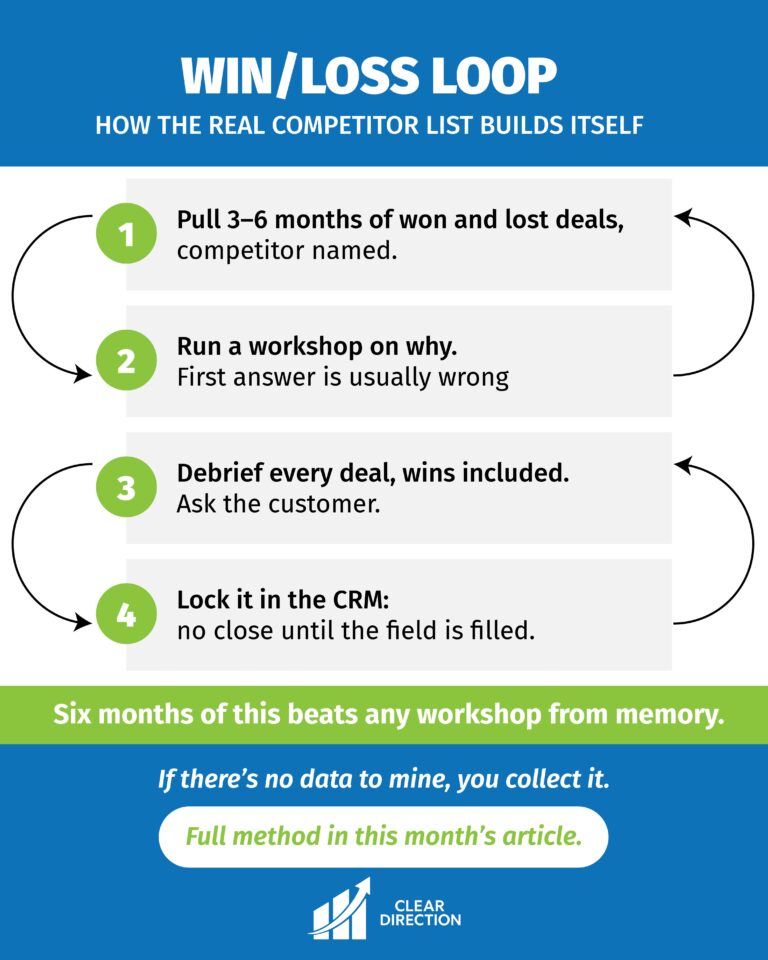
- Pull the last three to six months of won deals and who you competed against.
- Pull the lost deals and who you competed against.
- Run a workshop on why. The first visceral answer is often wrong, and the workshop produces a to-do list to go find out what actually happened.
If there is no data to mine, you collect it.
Make It Part of the Process
The go-forward fix is a debrief on every deal, wins included. I want to sit down with the client I won and have them tell me why; it signals that these people actually care, and it keeps the relationship open. Embed it in the CRM as a locked field, no advancing the opportunity until it’s done, and the same data feeds next year’s strategy and budget.
A Client Whose Competitive Set Was Wrong
A client was fixated on two competitors close to home, largely because they’d traded employees back and forth. When we ran the analysis, the real threats were outside the region, in the markets this company actually wanted to grow into.
The fix wasn’t the product. It was positioning. They led with speed and delivery, and it turned out they were faster than the nearby competitor who’d been selling “we’re local, so we’re quicker.” Stepping back from the emotional read to the real one changed where the company spent its energy.
What Does a Competitive SWOT Look Like When It Actually Works?
A SWOT is one of the most common exercises in business and one of the least used. The pattern is familiar: the team brings a mountain of information together, produces a thoughtful report, and then the business pulls everyone back to running the business. The report isn’t bad. It’s just alone.
Institutionalize It
The fix is to make it part of the process, not a poster on the wall. The SWOT doesn’t get refreshed by scheduling a meeting about it; it gets refreshed by the data that arrives every time a deal closes. So build the feed first:
- Make the debrief a closeout step. Every won and lost deal records who you competed against and why you won or lost, as a required field in the CRM before the opportunity can close.
- Let the data accumulate. Six months of that and you have a real picture of your competitive set, by segment and deal size, that no workshop could produce from memory.
- Read the SWOT against it. When the debriefs start telling you something different from what’s on the wall, the world changed, and the document changes with it.
Done this way, the SWOT stops being an event. It becomes the summary of what your own deals have been telling you, and it stays current because the process feeds it, not because someone remembered.
And weight the opportunities over the threats. Opportunities have a clock; a competitor’s stumble is a six-month window, not a standing advantage.
Who Is in the Room
The executive team tends to believe it has a complete view of the market. It usually doesn’t, and neither does the sales team alone. You need the customer, operations, engineering, marketing, and finance, because each sees things the executive team isn’t thinking about.
That doesn’t mean one enormous meeting. Give each area the executive team’s draft and let them react in their own sub-meetings, through a lead they trust, because front-line people won’t speak up in a room with the CEO’s arms crossed.
This is why I like the big version on the wall. Early in my career I was running a new company, put the plan up for everyone, and a member of my administrative staff came to me with a process change in how we worked with intermediaries and clients. We made it, and we went from selling 500 units a year to almost 4,000. It came from a person a traditional SWOT would never have included.
Where Are Your Customers Actually Clustered?

Most owners don’t have a good handle on where to deploy people, and many want everything close to home: decision makers close, salespeople close. That’s fine until you notice you’re in a small town and can’t find the talent to do what you’re trying to do.
Three Maps, Not One
Look at three concentrations, not one:
- Where your existing customers are.
- Where your competitors are. A dense competitive area isn’t automatically one to avoid; more competition can force you to sharpen your differences in a healthy way.
- Where the opportunity is. You may have zero customers in a region simply because you’ve never sold there. That empty spot might be the biggest growth opportunity you have.
All three feed the same downstream decisions: quota design and territory strategy.
What It Changes
A client in a small town was trying to hire high-end salespeople locally, at real expense, and struggling. We ran the analysis in their CRM and the customers were in three major metros hundreds of miles away. So why are we hiring here?
We put salespeople where the customers were and saw phenomenal growth. The hard part wasn’t the map. It was the mindset that everything had to be in-house.
When the Dense Market Is the Wrong One
Density can point you at the wrong answer. A client looked at where its existing customers were concentrated and concluded it needed another salesperson in that geography. When we peeled it back by industry instead of by customer count, one industry they served had big concentrations in two regions outside the country.
They weren’t ready to put salespeople there, but they could work through channel partners already serving those customers. It produced millions in sales.
What Is Your Market Share, Honestly?
Estimating share with no research budget is very different than it was five years ago. AI-driven tools can now assess share, show a small company there’s market available where it thought it was saturated, and target new areas without shotgunning. Getting to a real number is faster than it has ever been.
A Number Is Not a Strategy
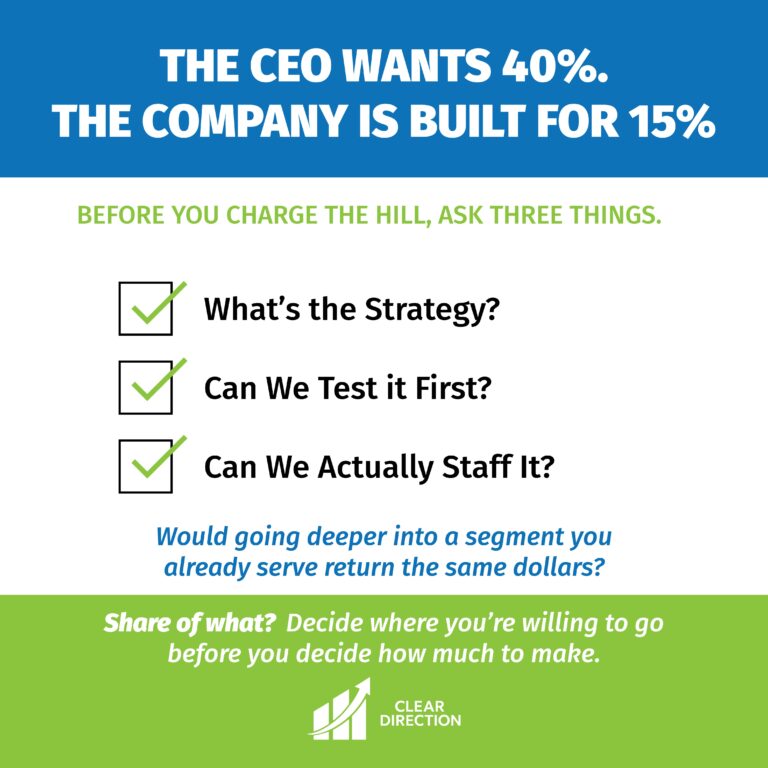
That’s exactly where the caution goes. It’s easier to find the opportunity now, which makes it easier to charge up a hill because a tool said so. Before committing dollars, ask three things: what’s the strategy, can we test it first, and can we actually staff it? And check whether going deeper into a segment you already serve would return the same dollars.
What the Number Changes
Look at customer count next to revenue. I’ve sat with a CEO who put the revenue figures on the table, and within five minutes I asked how many customers that was. If the revenue is concentrated in three clients and you’ve got forty in the smaller-dollar category, those forty may be your best target.
Share of What?
The boundary question comes down to two things: where are we today, and what are we willing to go into, by geography, vertical, or market presence? That work has to happen first, because it may limit the scope in a way the CEO doesn’t want to hear. A CEO who needs 40% growth may be running a company whose talent, appetite, and market opportunity support 15%.
Then model it. What does it cost to get in, and if break-even is year two, is the owner okay with a loss in year one? It forces the question that matters: these dollars here, or deeper in what we already do?
Competitive Landscape: Quick Answers
Why is the competitor list usually wrong? Because it comes from memory. Salespeople remember the last deal they lost; owners remember the last customer they lost. Neither has checked the CRM or asked the customer.
How do I find out who I’m really losing to? Pull three to six months of wins and losses from the CRM with the competitor named, run a workshop on why, and ask the lost customers directly. Then make the debrief a locked step in the CRM on every deal going forward.
Is a SWOT worth doing? Yes, if the debrief on every closed deal feeds it and voices beyond the executive team shape it. Done once and filed, it isn’t worth doing.
How do I estimate market share without a research budget? AI-driven analysis can produce a usable estimate quickly. The harder part is deciding what you’re willing to go into and whether the company can act on it. A number without a strategy is a shiny object.
Where a Fractional Sales Leader Earns the Seat
Everything above has one common thread: it decays. The competitor list is stale within a year, the SWOT within a quarter, the map the day a competitor opens nearby. Most owners know this. What they don’t have is anyone whose job it is to keep the analysis alive while they run the business.
That’s the gap a fractional sales leader fills, and the value isn’t the analysis. An owner can commission a SWOT from anyone. The value is what happens after:
- Four boxes on a whiteboard become a sales plan with named targets, owners, and dates.
- The win/loss debrief gets wired into the CRM so the plan keeps feeding itself.
- The SWOT gets re-read against that data as it accumulates, so it stays current whether or not anyone remembers.
- The growth number the CEO wants gets modeled against what the company can actually execute.
That’s the difference between a document and a process. The companies that compete well aren’t the ones with the best analysis; they’re the ones who built it into how they sell.
If your competitor list came out of memory, your last SWOT is in a drawer, and your growth target was set before anyone checked your share, that’s the conversation to have. I’m offering a free 30-minute conversation about your competitive set this month — bring the list, or the SWOT from the drawer, and I’ll tell you what I see. Book a time here: Scheduling Tool or contact me at (512) 808-6691 or js@cleardirection.io.
———————————————————————————–
I am part of a national group of Senior Sales Leaders who collaborate to share insights like the examples shown in this article. We formed because of our shared passion to help business leaders exponentially expand their revenue.